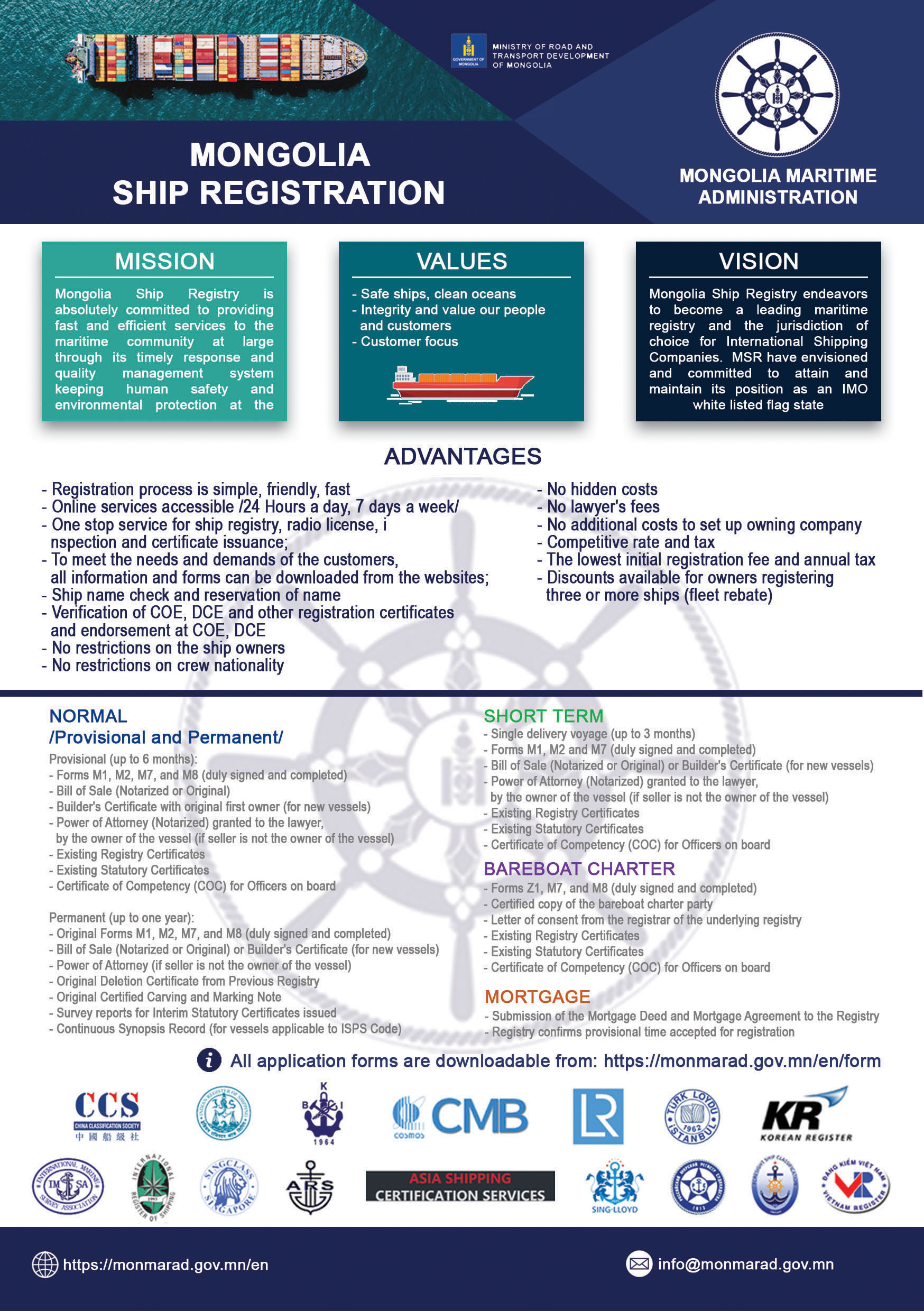
MONGOLA SHIP REGISTRATION
Mongolia, a landlocked developing country, actively participates in international trade on equal terms with coastal states. The government ensures smooth foreign trade by resolving transit issues through neighboring nations, securing reliable maritime access, and operating shipping services.
Mongolia became a member state of the International Maritime Organization (IMO) in 1996 and has ratified over 30 international maritime conventions and treaties to manage its ship registry and adhere to global standards, including the 1982 UN Convention on the Law of the Sea (UNCLOS), the 1958 Convention on the High Seas, and the Maritime Labour Convention (MLC, 2006).
While Mongolia is the largest landlocked country in the world, ships registered under its flag total more than 800.000 gross tonnage of shipping. As of today, Mongolia Ship Registry registered approximately 4700 vessels while around 300 vessels having regular registration.
Under international law, Mongolia is entitled to fly its national flag on vessels. Since 2003, Mongolia has operated an open ship registry, initially in Singapore, and today all registration operations are managed from the capital city of Ulaanbaatar, Mongolia.
The Mongolia Ship Registry offers various types of vessel registration: normal (Provisional and Permanent), short-term Single Delivery Voyage, Mortgage, and Bareboat charter. Mongolia has registry agents in five countries and collaborates with Recognized Organizations such as Lloyd’s Register, Korean Register, China Classification Society, Indian Register of Shipping, and the Russian Maritime Register of Shipping to conduct technical inspections and surveys.
Our registry operates under a fully accredited quality management system in compliance with ISO 9001:2000 and ISO 9001:2015 standards, offering competitive rates and fees.
To enhance vessel oversight, we use the Long Range Identification and Tracking (LRIT) system. RO surveyors and Flag state inspectors are appointed in accordance with international treaties and standards to ensure vessel safety, improve registry operations, and reduce detentions.